COMPATIBILITY
The old rule stopped being true
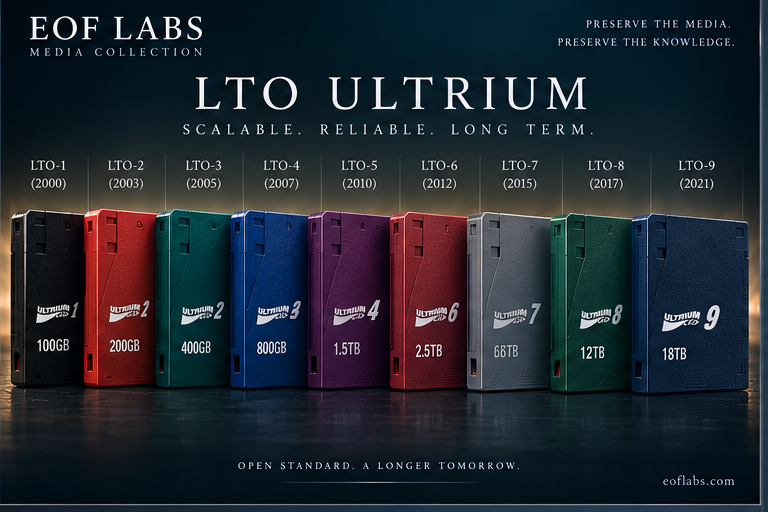
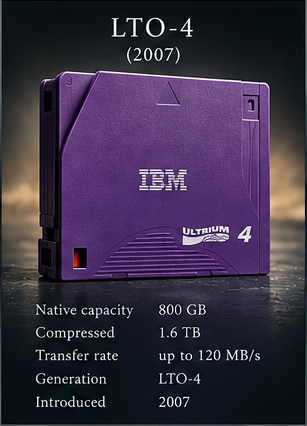
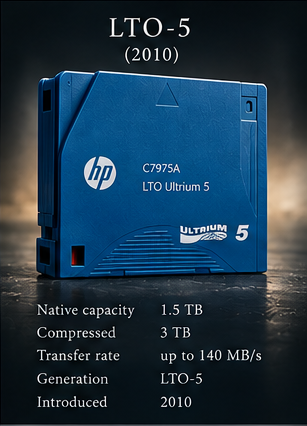
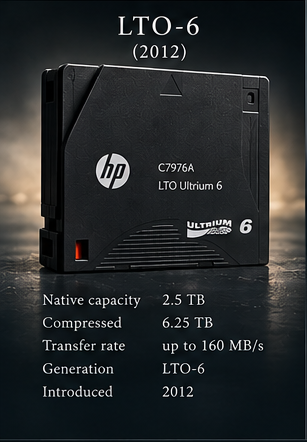
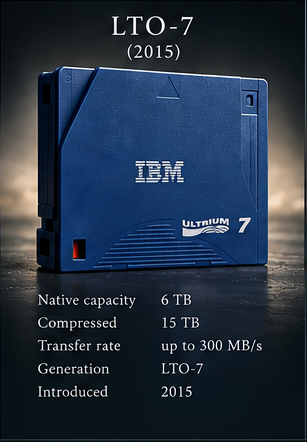
For LTO-1 through LTO-7, the broad rule was: a drive reads its own generation and the two previous generations, and writes its own generation plus the immediately previous one. That makes an LTO-3 drive a useful bridge for early LTO-1/2/3, an LTO-6 drive useful for LTO-4/5/6, and an LTO-7 drive useful for LTO-5/6/7.
| Drive | Reads | Writes | Archive consequence |
|---|
| LTO-3 | LTO-1 / 2 / 3 | LTO-2 / 3 | Useful early-generation bridge. |
| LTO-6 | LTO-4 / 5 / 6 | LTO-5 / 6 | Cannot read LTO-3 despite identical shell size. |
| LTO-7 | LTO-5 / 6 / 7 | LTO-6 / 7 | Last classic “read two generations back” generation. |
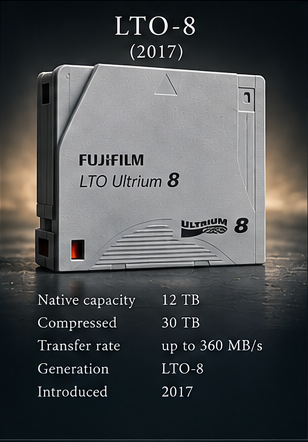
| LTO-8 | LTO-7 / 7 Type M / 8 | LTO-7 / Type M / 8 | No LTO-6 support. |
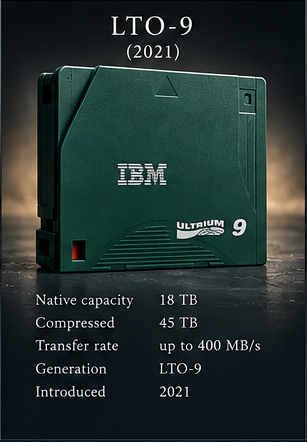
| LTO-9 | LTO-8 / 9 | LTO-8 / 9 | No LTO-7 support. |
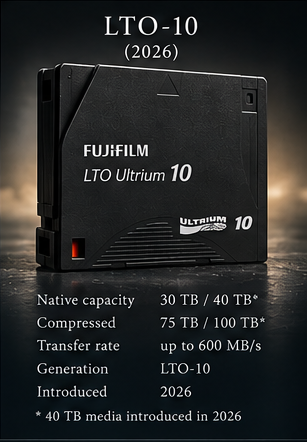
| LTO-10 | LTO-10 only | LTO-10 only | No backward read path; older media requires older drives. |
Recovery rule: verify the exact drive generation before loading irreplaceable media. “Newer LTO drive” no longer means “better chance of reading an old LTO cartridge.”
WORM · ENCRYPTION · LTFS
The cartridge may be readable yet the files still inaccessible
WORM. Write Once Read Many cartridges exist for generations intended for compliance and immutable retention. A WORM cartridge is not simply a normal cartridge with a filesystem flag; the drive recognises the media type and enforces write restrictions.
Encryption. Hardware-based tape encryption became a mainstream LTO feature with LTO-4. Recovering an encrypted cartridge requires the correct key-management context. Physical readability does not bypass encryption.
LTFS. LTO-5 introduced partitioning used by the Linear Tape File System. LTFS can make tape resemble a filesystem, but it remains sequential media underneath. Not every later LTO cartridge is LTFS; many still contain proprietary backup formats or application-specific streams.
Cartridge memory. LTO cartridges contain non-contact cartridge memory used for media information and usage metadata. It is useful diagnostic context but is not a substitute for reading the tape recording.
DRIVES + INTERFACES
The host side changed too
Early LTO commonly appears as parallel SCSI, then Fibre Channel and SAS become dominant. Library drives may be physically identical to standalone mechanisms but depend on library robotics, firmware or management context. A recovered drive therefore needs the right transport interface, host bus adapter, cabling, firmware support and operating-system tape driver before media diagnosis begins.
WHAT SURVIVES
A tape is not a backup format
LTO may hold raw tar, cpio or dump, NetBackup, NetWorker, Backup Exec, IBM Spectrum Protect/Tivoli Storage Manager, application-specific streams, database dumps, video archives, scientific datasets or LTFS. Multi-volume sets, catalogues, encryption keys and original software versions may matter as much as the cartridge.
RECOVERY
Separate transport recovery from data interpretation
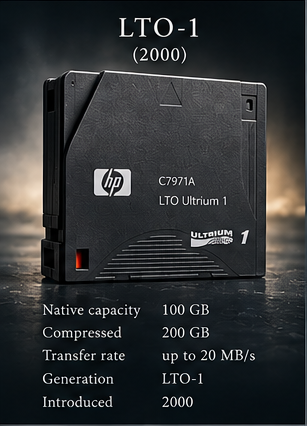
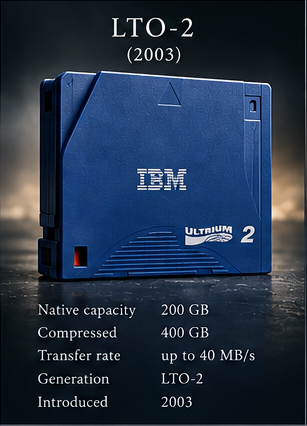
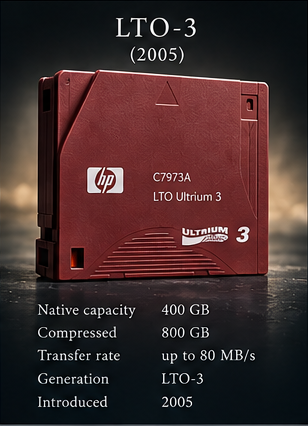
Identify the generation. Read cartridge markings and barcode conventions before choosing a drive.
Verify the drive with expendable media. Confirm load, unload, positioning, read and cleaning behaviour before inserting unique archival media.
Establish the interface. SCSI, SAS or Fibre Channel problems can masquerade as media errors.
Acquire read-first. Preserve filemarks and tape-file boundaries. Avoid trial writes or unnecessary rewinds.
Determine logical format afterwards. Work from the acquired stream where possible, then identify backup software, LTFS, encryption, block size, volume order and filesystem structures.
The recovery stack is cartridge → compatible generation drive → interface/HBA → OS tape device → recorded stream → backup or archive format → files.