
QIC & Travan
One of the most fragmented tape ecosystems: professional data cartridges, floppy-controller tape, minicartridges, Travan and later Tandberg descendants.
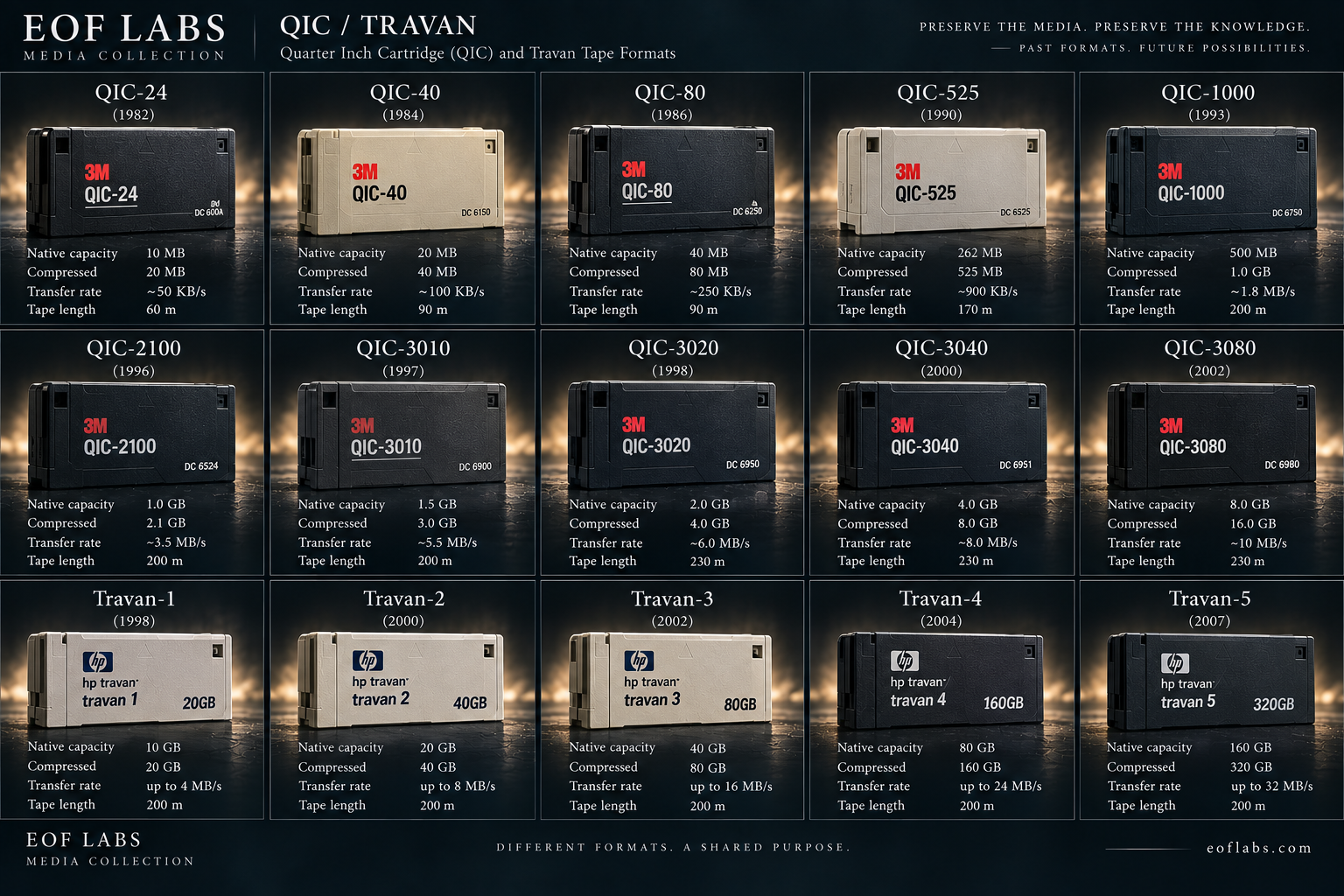
A cartridge standard became an ecosystem
QIC began as a quarter-inch cartridge standard and evolved into a large family of recording standards. Cartridge size alone does not identify what is on the tape. Track count, linear density, encoding, controller command set, tape length and drive generation can all differ while the media remain visually similar.
The QIC standards archive is especially valuable because it preserves the recording specifications themselves. Capacity references below are native/uncompressed unless stated otherwise.
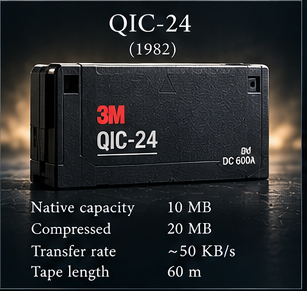
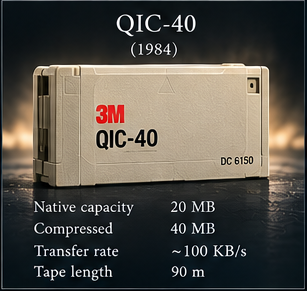
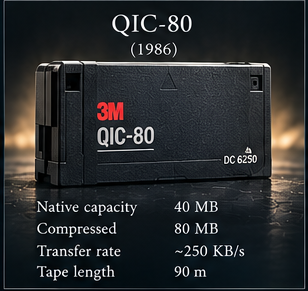
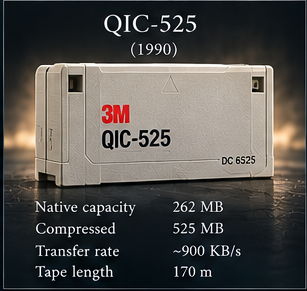
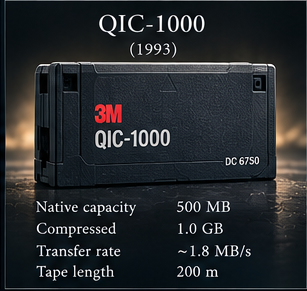
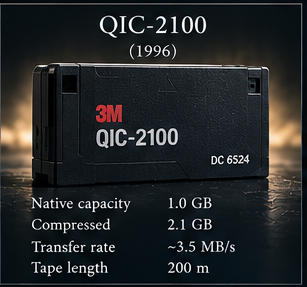
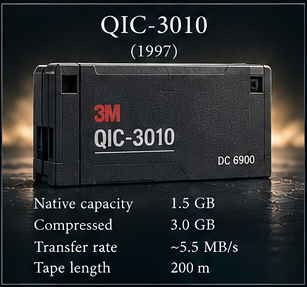
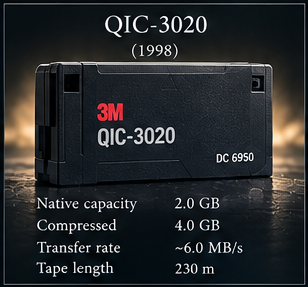
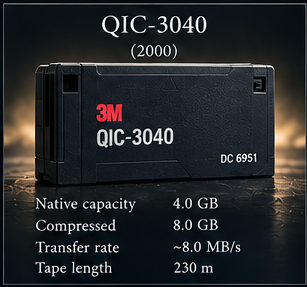
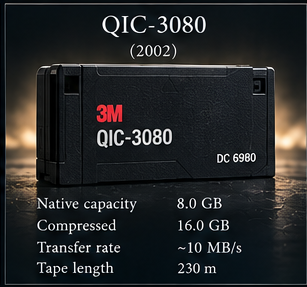
The recording designation matters more than the shell
| Standard / family | Native capacity | Recording detail | Typical context |
|---|---|---|---|
| QIC-24-DC | 60 MB | 9 tracks · 10,000 ftpi · GCR | Early professional data cartridge |
| QIC-40-MC | 40 MB | 20 tracks · 10,000 bpi · MFM | PC floppy-controller tape |
| QIC-80-MC | 80 MB baseline | 28 tracks · 14,700 bpi · MFM | PC floppy-controller tape |
| QIC-525-DC | 525 MB | 26 tracks · 20,000 ftpi · GCR + ECC | Professional/SCSI cartridge |
| QIC-1000-DC | 1,010 MB | 30 tracks · 45,000 ftpi · GCR + ECC | Higher-capacity professional QIC |
| QIC-2100-DC | 2.1 GB | 30 tracks · 50,800 ftpi · RLL + ECC | Later professional QIC |
| QIC-3010-MC | 340/425 MB baseline | 40/50 tracks · 22,125 bpi · MFM | Later PC/minicartridge |
| QIC-3020-MC | 680/833 MB baseline | 40/50 tracks · 42,000 bpi · MFM | Later PC/minicartridge |
| QIC-3040-MC | 840 MB / 1 GB | 42/52 tracks · GCR + ECC | Later minicartridge |
| QIC-3080-MC | 1.6 GB | 60 tracks · RLL + ECC | SCSI/ATAPI-era minicartridge |
Backward-read paths exist, but they are not universal
The QIC cross-reference records migration relationships between selected standards. QIC-80-era drives may read QIC-40 recordings in documented configurations; later QIC-3010 and QIC-3020 families extend selected backward paths. That is not the same as saying every later drive writes every earlier format.
FDC tape, SCSI tape and ATAPI tape are different recovery problems
QIC-40/80 and related PC tape drives use the floppy-controller environment defined by QIC command standards such as QIC-117. A modern USB floppy drive is not equivalent: it hides the low-level controller timing and tape-specific command behaviour that these transports expect.
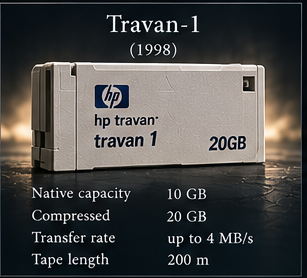
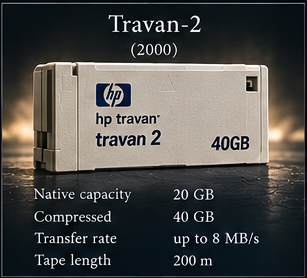
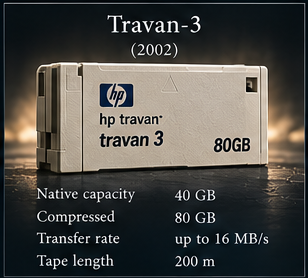
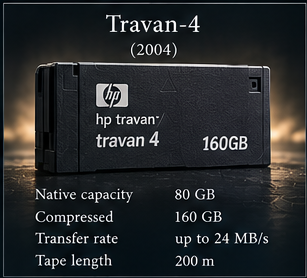
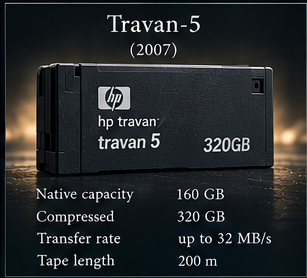
A QIC-derived cartridge family with its own generations
Travan widened the small-cartridge branch for PC and small-server backup. TR-1 through later TR generations and NS variants differ in capacity and supported transports. Some products inherit QIC recording concepts, but a “Travan-compatible” label is not enough to establish read/write compatibility across the entire line.
Record the full cartridge designation and the writing drive if known. Later Tandberg MLR/SLR products share lineage with QIC but should be treated as their own compatibility families.
A tape technology is not a backup format
Professional QIC frequently contains tar, cpio, dump, workstation source trees and CAD data. PC QIC/Travan often contains Colorado Backup, Seagate/Veritas Backup Exec and other proprietary streams. Multi-volume sequencing and application catalogues may be required even after a stable physical read.
Recording standard → transport → controller → stream → backup format
Identify the QIC/Travan recording designation and cartridge, source a documented compatible drive, preserve the original controller/host where possible, verify the drive with expendable media, write-protect the archival source and acquire the sequential recording while preserving filemarks and block behaviour. Interpret tar, dump or proprietary backup structures from the copy.
Standards and compatibility records
QIC — Adopted standards index ↗
QIC — Standards cross-reference / migration matrix ↗
QIC — Technology and migration paths ↗
IBM — legacy tape drive/media characteristics ↗