
Floppy disks
8-inch, 5.25-inch and 3.5-inch disks are physical families, not file formats. Geometry, magnetic encoding, controller behaviour and host conventions determine what can be recovered.
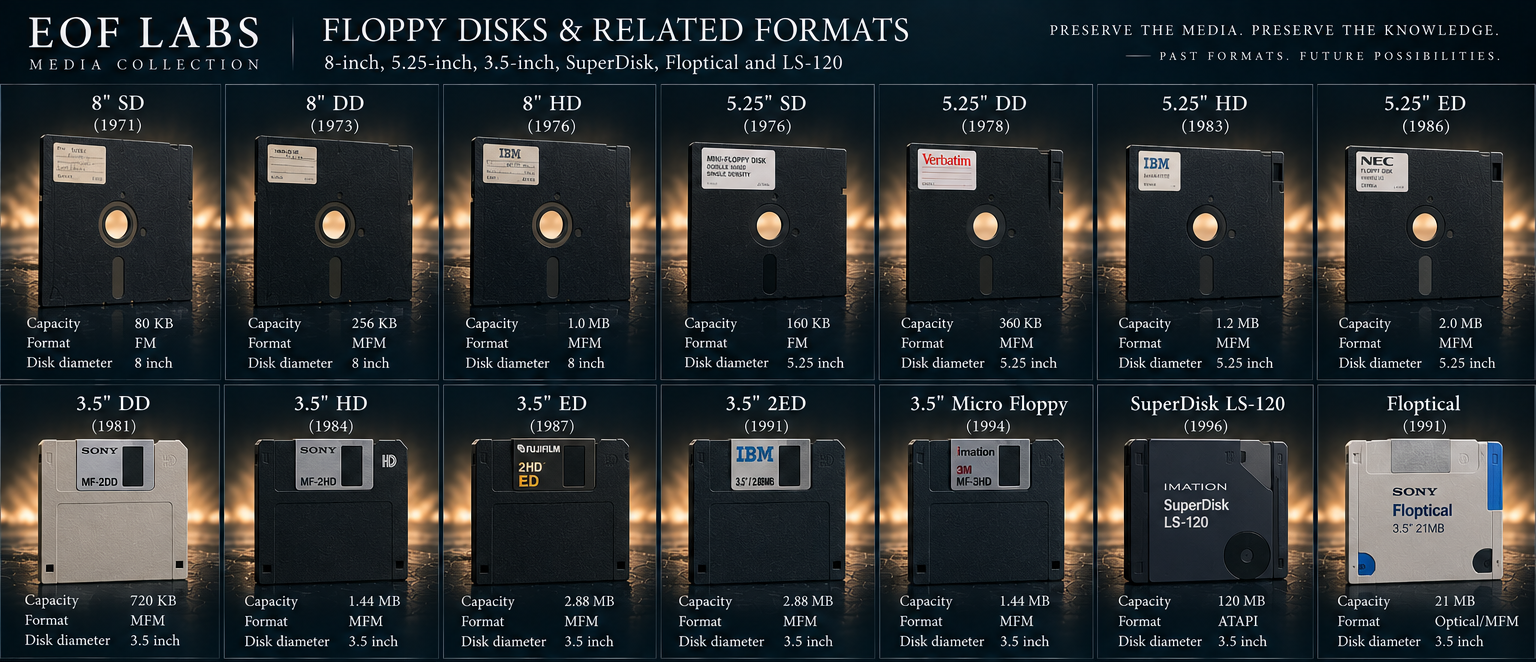
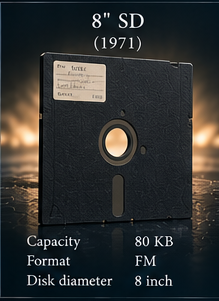
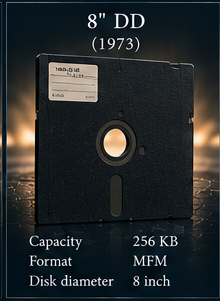
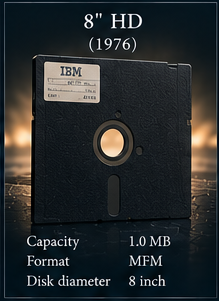
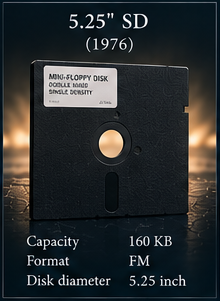
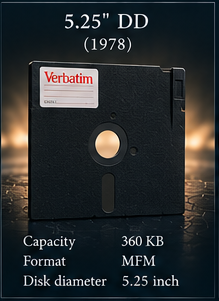
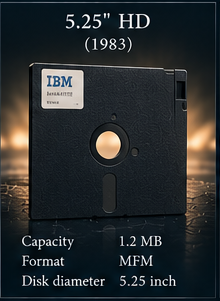
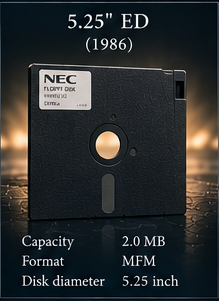
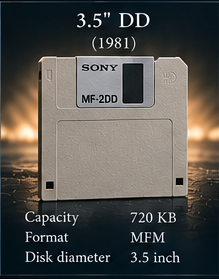
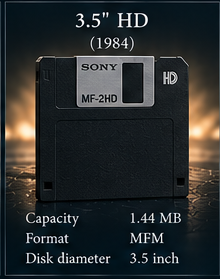
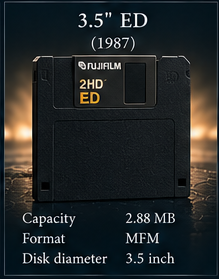
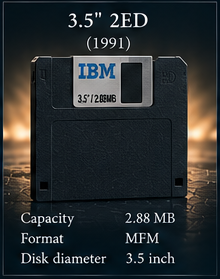
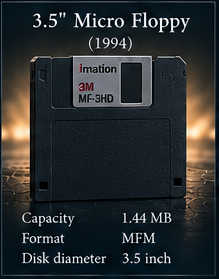
Size alone says very little
| Carrier | Representative standard | Recording / geometry | Preservation significance |
|---|---|---|---|
| 200 mm / 8-inch | ECMA-54 | two-frequency / FM class; 13,262 flux transitions per radian | Early single-density interchange. |
| 200 mm / 8-inch | ECMA-69 | MFM, double-sided | Same broad carrier size, different encoding and interchange assumptions. |
| 130 mm / 5.25-inch | ECMA-66 | 35-track class | Demonstrates that 5.25-inch is not synonymous with PC 40-track. |
| 130 mm / 5.25-inch | ECMA-70 | MFM, 40 tracks per side | Classic 40-track interchange class. |
| 130 mm / 5.25-inch | ECMA-78 | MFM, 80 tracks per side | 80-track class; drive stepping becomes an interoperability issue. |
| 90 mm / 3.5-inch | ECMA-100 | 7,958 ftprad; 80 tracks per side | Type 301 interchange family. |
| 90 mm / 3.5-inch | ECMA-125 | 15,916 ftprad; 80 tracks per side | Type 302 / higher linear density. |
| 90 mm / 3.5-inch | ECMA-147 | 31,831 ftprad; 80 tracks per side | Type 303 / still higher density. |
Tracks and sectors are hypotheses until verified
A disk image becomes meaningful only after determining sides, tracks, sectors per track, sector size, encoding, data rate and rotational assumptions. PC media commonly uses 512-byte sectors, but CP/M and specialist systems can use different sector sizes, skew and interleave. 5.25-inch mechanisms can be 35/40/77/80-track; reading a 40-track disk in an 80-track mechanism can require deliberate double-stepping.
Hard-sectored media uses physical index holes to mark sectors; soft-sectored formats derive sector boundaries from recorded data. A controller designed for one cannot simply be assumed to interpret the other.
FM and MFM are only part of the signal layer
| Encoding / framing | Where encountered | Why it matters |
|---|---|---|
| FM / two-frequency | early 8-inch and single-density systems | Later commodity USB floppy devices often cannot expose arbitrary FM structures. |
| MFM | IBM PC, CP/M, industrial systems | Common encoding does not imply PC geometry or FAT. |
| Apple GCR | Apple II and early Macintosh branches | Different encoding/framing from PC MFM. |
| Commodore GCR | 1541-family and related disks | Different GCR scheme with zone-dependent sectors per track. |
| Platform-specific MFM | Amiga and others | Flux may look MFM-like while sector framing remains platform-specific. |
Choose sector or flux capture deliberately
| Source | Ordinary USB floppy | Legacy FDC + correct drive | Flux capture |
|---|---|---|---|
| Standard PC 3.5-inch 1.44 MB | usually adequate for logical sector image | yes | yes |
| 720 KB / uncertain geometry | model-dependent | often | preferred when provenance is uncertain |
| 5.25-inch 40/80-track MFM | generally unsuitable | yes, correctly configured | preferred for preservation/damage |
| Apple / Commodore GCR | no generic path | specialised hardware | preferred general preservation layer |
| Amiga / platform-specific sectors | no generic path | specialised | useful |
| 8-inch FM/MFM / hard-sectored | no | specialist hardware | possible only with a compatible drive/interface solution |
This is an EOF Labs preservation decision model derived from the physical standards and capture-tool capabilities; it is not itself an ECMA compatibility table.
Capture the signal before deciding what it means
A conventional sector image records sectors the controller successfully decoded. Flux capture records transition timing and can preserve unknown encodings, damaged headers, weak reads and copy-protection structures for later analysis. The Library of Congress documents KryoFlux Stream as a flux-transition representation and describes institutional workflows where flux capture enables repeated later interpretation without repeatedly exercising original media.
KryoFlux, Greaseweazle, Applesauce and related systems differ in hardware, capture formats and decoding ecosystems. Preserve the raw acquisition as well as any decoded IMG/IMA/ADF/D64 or other derivative.
The first read may contaminate the next one
Inspect media before loading. Mould, oxide/binder deterioration, debris, warped jackets and damaged liners can contaminate heads rapidly. If read quality suddenly collapses across otherwise good disks, stop and inspect the drive rather than continuing through a batch. Preserve labels, sleeves, notches and write-protect state as provenance.
Later magnetic disks added optical servo guidance
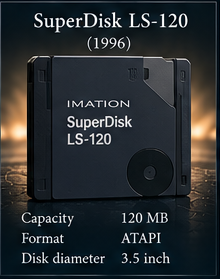
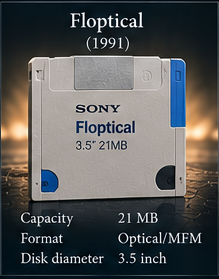
LS-120 and LS-240 SuperDisk use high-capacity magnetic media with optical servo guidance; compatible drives can also read conventional 3.5-inch floppy media. Floptical similarly combines magnetic recording with optical tracking. These are not ordinary floppy formats despite superficial similarity and require their own transports.
Provenance → signal → sectors → filesystem → files
Document source machine and disk markings; choose the appropriate drive/controller; acquire a sector image only when the format is confidently known and healthy; otherwise preserve flux; retain the raw acquisition; decode geometry and sector structure from a copy; then identify filesystem or application format. Avoid automatic filesystem repair on original media.
Open standards and archival practice
ECMA-54 — 200 mm flexible disk cartridge ↗
ECMA-69 — 200 mm MFM flexible disk ↗
ECMA-66 — 130 mm 35-track disk ↗
ECMA-70 — 130 mm 40-track MFM ↗
ECMA-78 — 130 mm 80-track MFM ↗
ECMA-100 — 90 mm Type 301 ↗
ECMA-125 — 90 mm Type 302 ↗
ECMA-147 — 90 mm Type 303 ↗
Library of Congress — KryoFlux Stream format description ↗
Library of Congress — flux/disk-image format description ↗
Library of Congress — preserving floppy-disk collections ↗