
Exabyte 8 mm,
Mammoth & VXA
Several 8 mm data-tape families whose cartridges can look related while their recording formats, media lengths and compatibility paths are not.
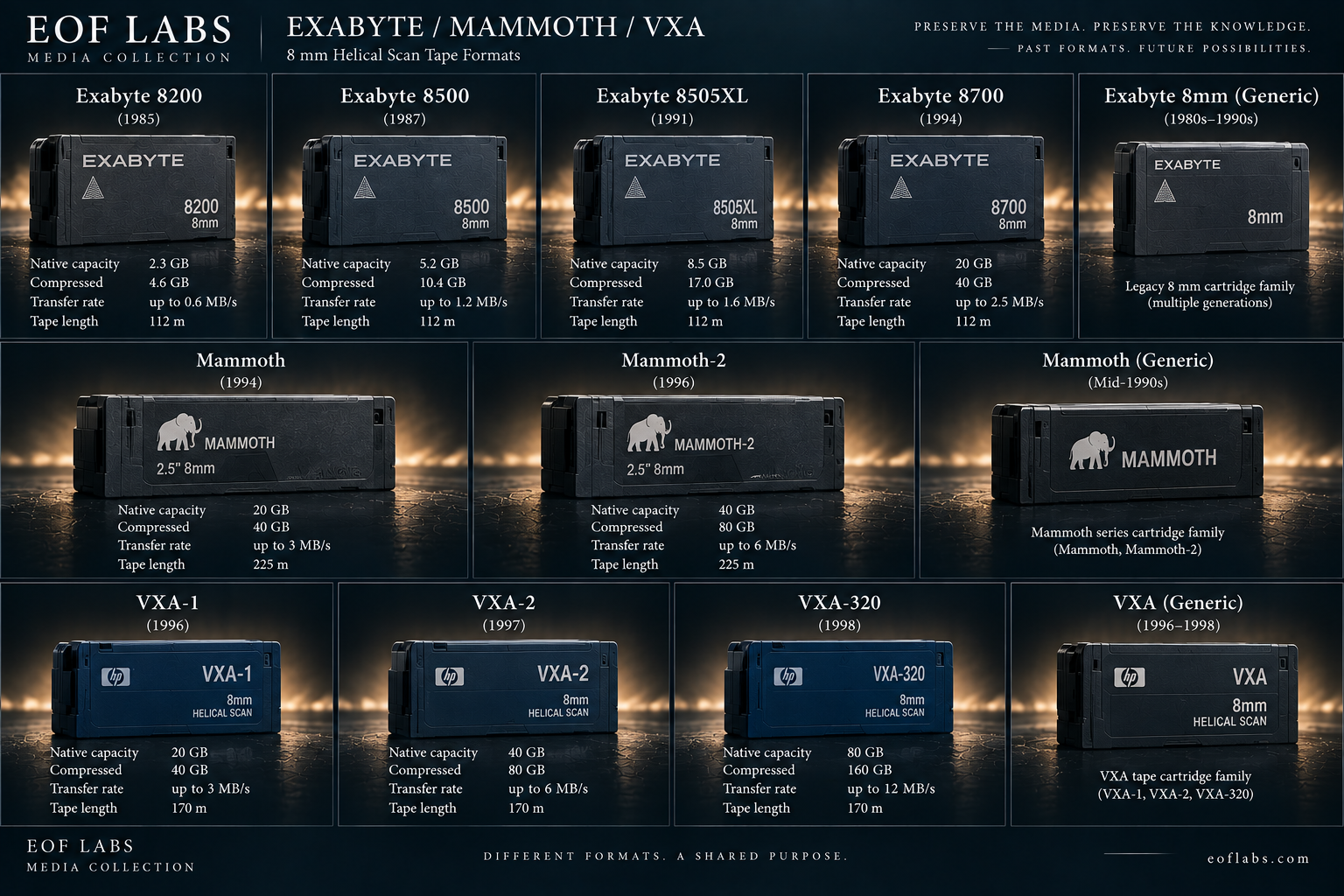
Video mechanics became workstation storage
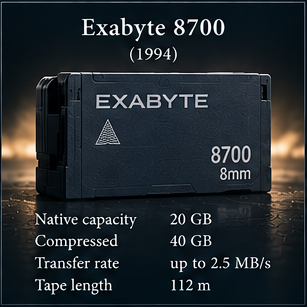
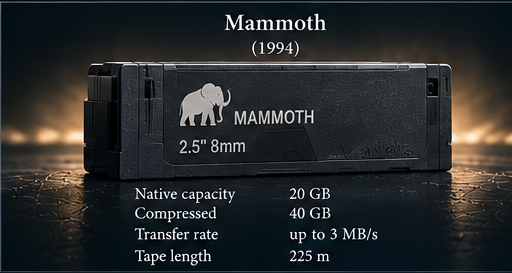
Exabyte adapted 8 mm video-style helical-scan mechanics for computer data, packing gigabytes into a compact cassette when Unix workstations and departmental servers needed denser backup. Data8 became common around Sun, SGI, engineering and scientific systems. Mammoth redesigned the platform for higher performance. VXA, acquired later by Exabyte, was a separate technology using a rotating-head helical transport and packet-oriented recording/error recovery.
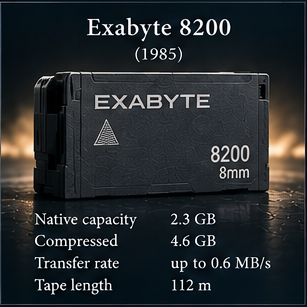
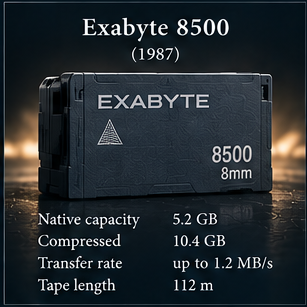
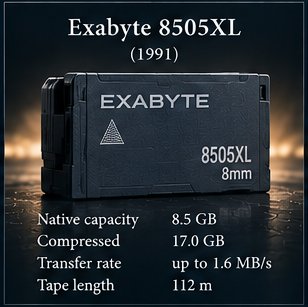
Capacity depends on both format and tape length
| Family | Media / drive | Native capacity | Native rate / significance |
|---|---|---|---|
| Early Data8 | FMT2GB class | 2.3 GB | ~245 KB/s class in IBM legacy matrix. |
| Data8 | FMT5GB | 5 GB | ~500 KB/s class. |
| Later Data8 | FMT7GB | 7 GB | ~500 KB/s class; longer/higher-capacity 8 mm recording. |
| Mammoth | EXB-8900 class | 20 GB | AME media; selected backward Data8 read paths depend on model. |
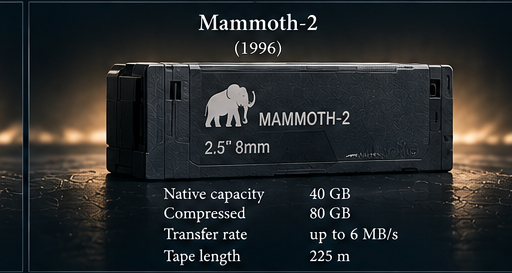
| Mammoth-2 | 225 m AME | 60 GB | IBM documents 60 GB media for Mammoth-2. |
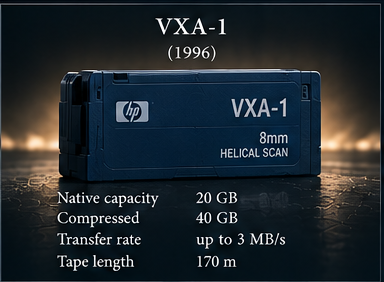
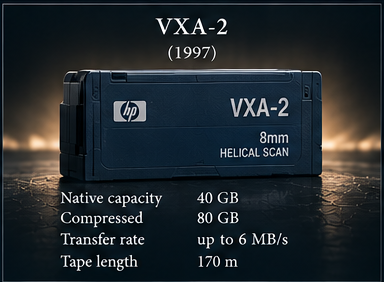
| VXA-2 | 60 / 170 / 230 m | 21 / 59 / 80 GB | 6 MB/s native class. |
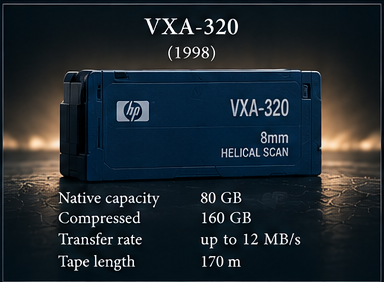
| VXA-320 class | 60 / 170 / 230 m | 40 / 80 / 160 GB | 12 MB/s native class. |
VXA packets sit on top of a helical-scan transport
Data8 and Mammoth write narrow diagonal tracks with rotating heads. IBM's VXA documentation explicitly describes VXA as a streaming, rotating-head helical-scan tape drive. VXA's distinctive Discrete Packet Format therefore describes the organisation and error-recovery model of the data; it does not make VXA a linear tape format.
Length, coating and drive generation all matter
Data8 uses metal-particle media in several lengths. Mammoth introduced advanced metal-evaporated media; Mammoth-2 uses AME media including the 225 m cartridge documented by IBM. VXA capacities similarly vary with 60, 170 and 230 m media. Record the full cartridge designation rather than normalising all media to the maximum capacity of the drive family.
The physical drive can outlive its supported software stack
IBM's current Storage Protect supported-device information retains historical entries for 8 mm technologies while noting that 8 mm drives are no longer supported in modern Storage Protect releases. For preservation this matters: a viable cartridge and drive may still require an older operating-system/HBA/software environment.
Unix and scientific working memory
Common contents include tar, cpio, dump, NetWorker, NetBackup, workstation home directories, source code, CAD, simulation output and laboratory datasets.
Family → drive → interface → stream → logical format
Record cartridge markings and provenance, select a documented compatible transport, establish SCSI or other appropriate connectivity, verify the drive, write-protect the source and acquire the sequential recording while retaining tape-file boundaries.
IBM legacy-device documentation
IBM — legacy tape drive/media characteristics ↗
IBM — Mammoth-2 drive/media configuration ↗
IBM — VXA-2 80/160 GB overview ↗
IBM — VXA-320 technology and helical-scan description ↗