
Enterprise
tape
IBM and StorageTek cartridges belong to systems of drives, libraries, volume labels, catalogues and host software. The cartridge is only one layer.
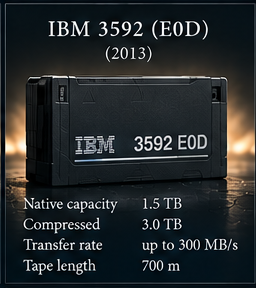
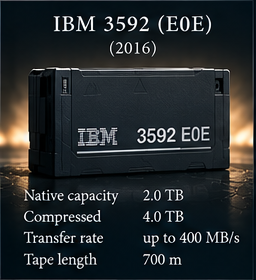
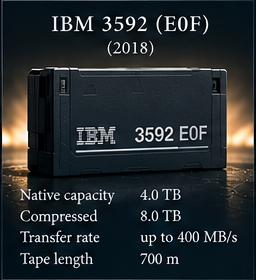
From 3480 to TS1170
| Family / drive | Native capacity / class | Technical significance |
|---|---|---|
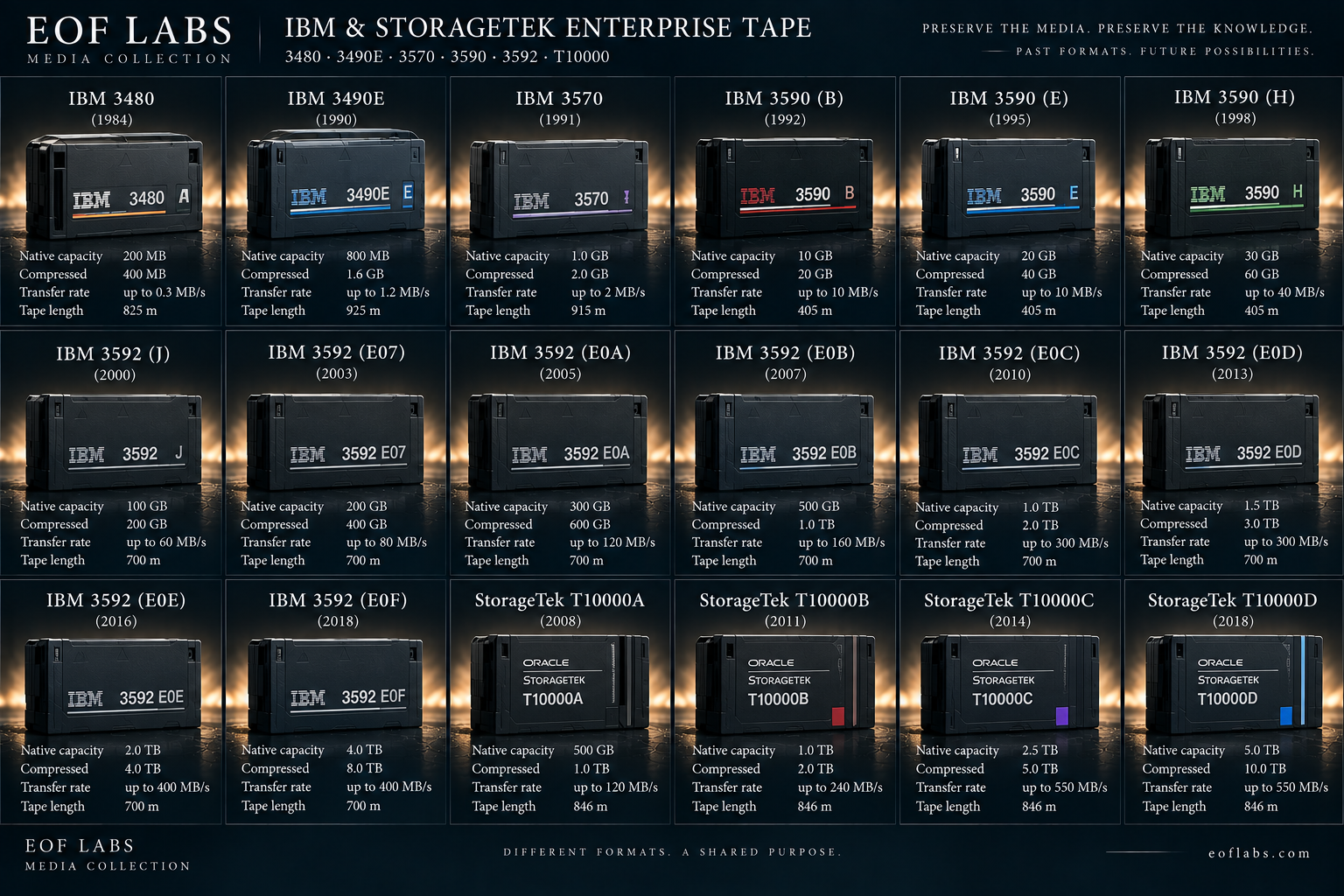
| 3480 / 3490 | 200 MB | 18-track cartridge generation that replaced much open-reel handling in mainframe environments. |
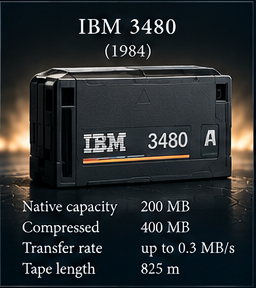
| 3490E | 400/800 MB class | 36-track recording and later extended-capacity media; selected backward-read paths exist. |
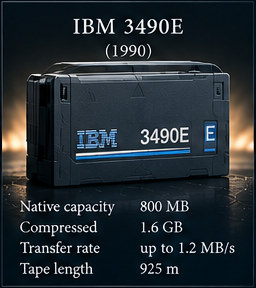
| 3570 Magstar MP | 5 GB baseline; later variants higher | Distinct two-reel midrange cartridge. It is not a small 3590. |
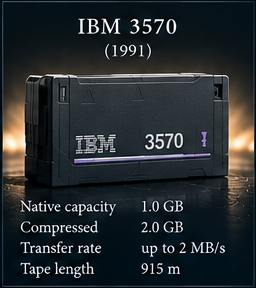
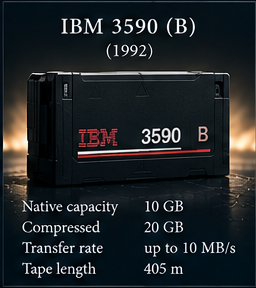
| 3590 B | 10/20 GB class | High-performance enterprise generation; no cartridge compatibility with 3480/3490 lineage. |
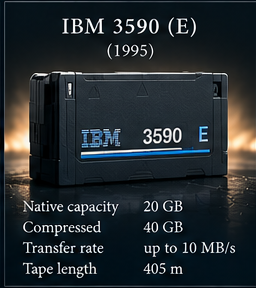
| 3590 E | 20/40 GB class | Higher-density 3590; reads supported earlier 3590 formats. |
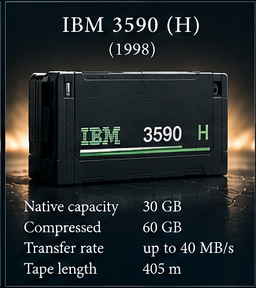
| 3590 H | 30/60 GB class | Later 3590 recording generation. |
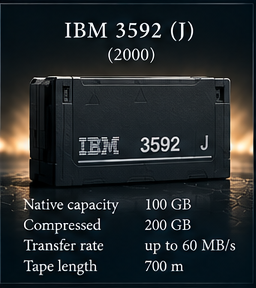
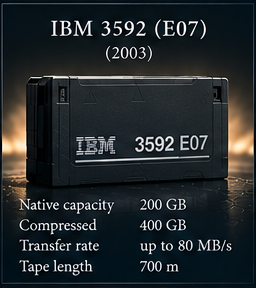
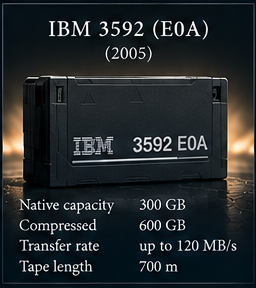
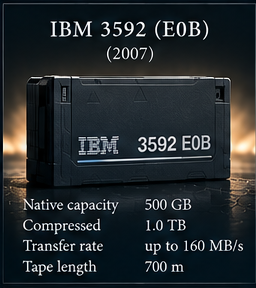
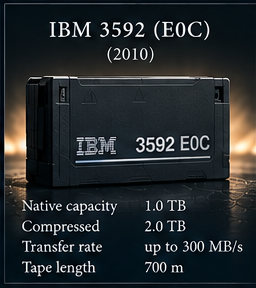
| 3592 J1A | up to 300 GB | First generation of the long 3592 family. |
| TS1120 | up to 700 GB | 3592 generation 2. |
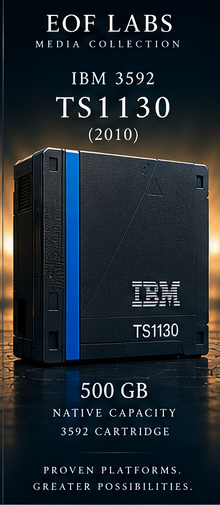
| TS1130 | up to 1 TB | 3592 generation 3. |
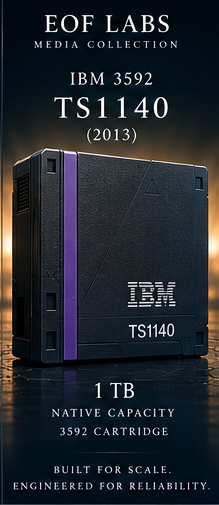
| TS1140 | up to 4 TB | 3592 generation 4; encryption/WORM/library context increasingly important. |
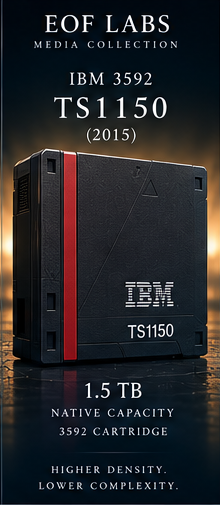
| TS1150 | up to 10 TB | 3592 generation 5. |
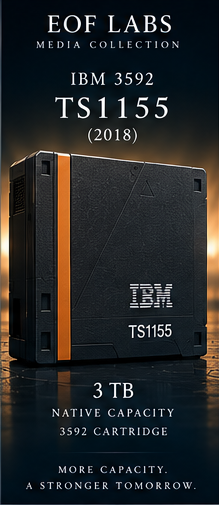
| TS1155 | up to 15 TB | 55F branch. |
| TS1160 | up to 20 TB | 60F generation and immediate predecessor to TS1170. |
| TS1170 | 50 TB JF | Major compatibility break: Type F/JF media only; previous-generation 3592 cartridges are not supported. |
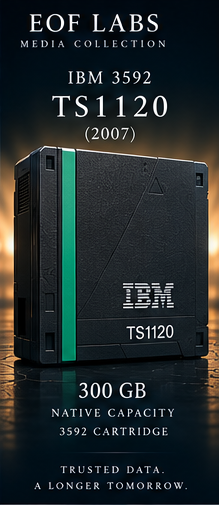
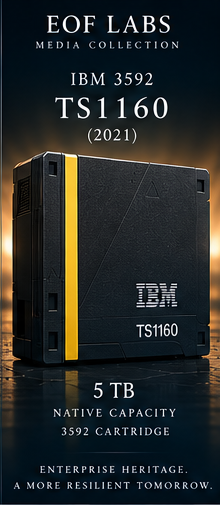
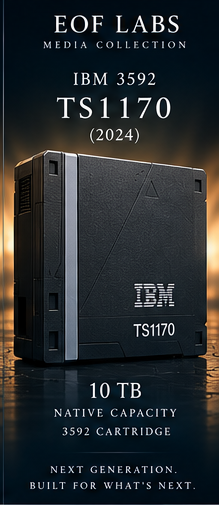
Recording format and cartridge generation are separate variables
3592 is a family, not a single recording. IBM's current compatibility tables describe drive generation, cartridge type and read/write state separately. Preservation inventories should therefore record the cartridge media code, barcode/VOLSER and likely writing generation rather than simply labelling a volume “3592”.
WORM media, encryption and key management add independent access conditions. A physically readable enterprise tape may still be logically inaccessible without the original key infrastructure or application catalogue.
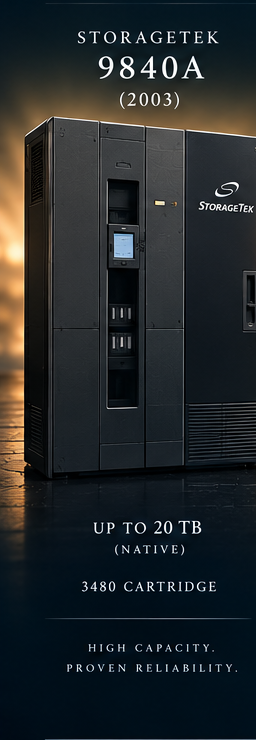
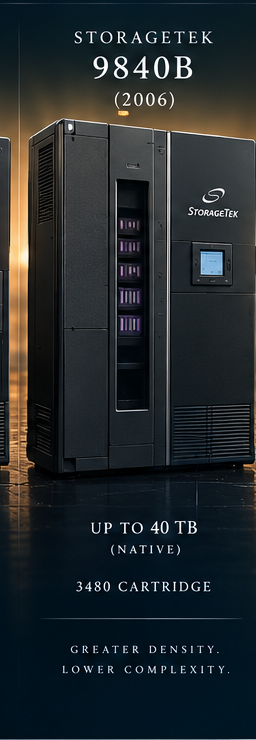
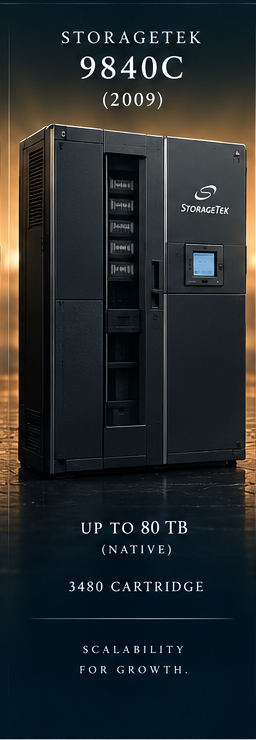
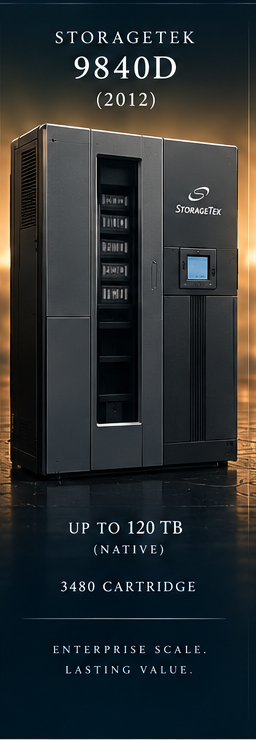
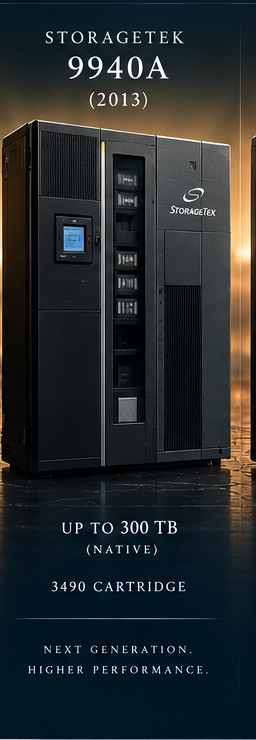
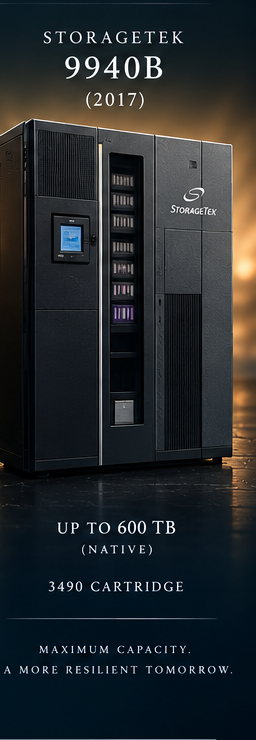
9840, 9940 and T10000 are recording families, not just shells
| Family | Native capacity | Technical point |
|---|---|---|
| 9840A / B | ~20 GB class | Dual-reel cartridge optimised for fast access in automated libraries. |
| 9840C | ~40 GB | Higher-density recording. |
| 9840D | 75 GB | 576 tracks, ~30 MB/s class, 271 m media in Oracle documentation. |
| 9940A | ~60 GB | Single-reel higher-capacity branch. |
| 9940B | ~200 GB | Higher-density 9940 recording. |
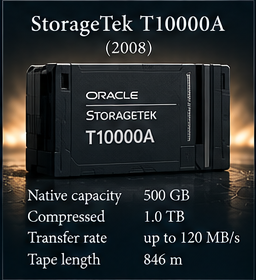
| T10000A | 500 GB | T1 media generation. |
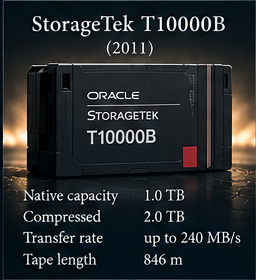
| T10000B | 1 TB | Can read A-format recordings, but Oracle documents asymmetric append/write behaviour. |
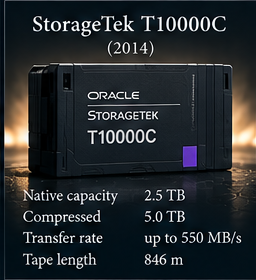
| T10000C | 5 TB nominal | T2 media; 3,584 tracks and ~252 MB/s class. |
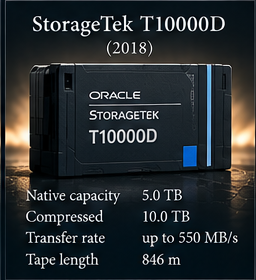
| T10000D | 8 TB nominal | T2 media; 4,608 tracks and ~252 MB/s class. |
Oracle explicitly documents an important T10000 asymmetry: a B drive can read A-format recordings but cannot simply append B-format data to an A-format recording; an A drive cannot read B-format data. Similar-looking media therefore cannot be treated as format-neutral.
Mainframe tape is record-oriented
A readable tape may contain standard IBM labels, labelled or unlabelled datasets, fixed or variable records, blocked records and EBCDIC text. Dataset name, record format, logical-record length and block size can be necessary to reconstruct the original data correctly. Treating everything as an undifferentiated byte stream can discard host semantics.
Backup products, hierarchical storage managers and virtual-tape systems add another layer. One cartridge may be one volume in a pool whose logical catalogue lived on another system.
The robotics are part of the evidence
Preserve barcode/VOLSER, slot maps, inventory exports, ACSLS data, library configuration and host/application catalogues alongside the cartridges. In large estates the physical order of media is rarely the logical order of datasets. Oracle ACSLS and IBM library/application catalogues can preserve relationships that cannot be inferred from a standalone tape read.
Reconstruct the system around the cartridge
Identify the exact cartridge/media code and likely writing drive; choose a documented compatible transport; establish Fibre Channel, SCSI or mainframe-era host connectivity as applicable; preserve volume labels, tape marks and record boundaries; acquire without altering the source; then decode host record formats and application structures. Seek encryption keys and catalogue databases before assuming a physically readable volume can be restored independently.
IBM and Oracle documentation
IBM z/OS — tape storage method and device context ↗
IBM — legacy tape drive/media characteristics ↗
IBM — LTO and 3592 drive model characteristics ↗
IBM — differences between 3590 B, E and H ↗
IBM — TS1170 generation 7 configuration and compatibility ↗
IBM Storage Archive EE — supported 3592 drives and media ↗
Oracle StorageTek — drives and media ↗
Oracle ACSLS — media characteristics ↗
Oracle — robotic/library configuration context ↗