
DLT &
Super DLT
DEC ancestry, Quantum server-room dominance and several recording branches whose physically similar cartridges require the correct generation of transport.
From DEC CompactTape to the server room
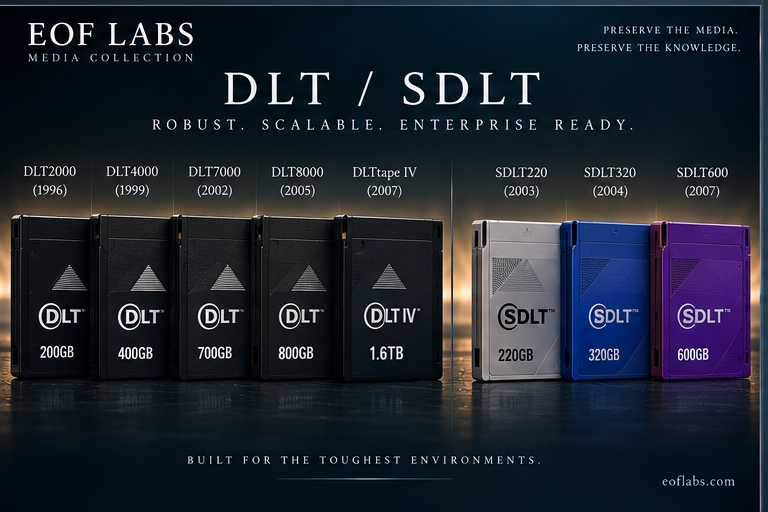
DLT descends from Digital Equipment Corporation's TK50/CompactTape technology. Quantum developed the later DLT line into a major workstation, server and robotic-library platform. DLT4000, DLT7000 and DLT8000 became characteristic 1990s backup drives. DLT VS created a lower-cost branch, while Super DLT introduced a revised recording platform and new media.
The key archival lesson is that DLT branding spans several partially overlapping technologies. A DLTtape IV cartridge can contain different recording densities depending on the drive that wrote it, and Super DLT support cannot be inferred from the fact that the cartridge looks related.
The useful map is drive × cartridge × recording density
| Artwork | Drive/family | Native capacity | Primary media | Archive significance |
|---|---|---|---|---|
| — | TK50 / TK70 | ~95 / 296 MB | CompacTape | DEC ancestry; treat as a separate early compatibility path until the exact DEC transport is known. |
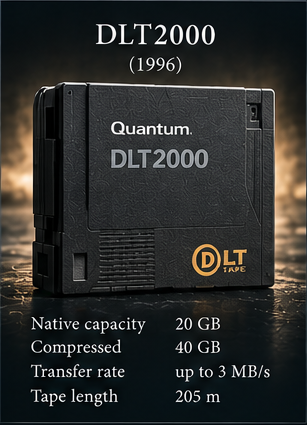 | DLT2000 / 2000XT | 10 / 15 GB | DLTtape III / IIIXT | Early DLT recordings can require period transports. |
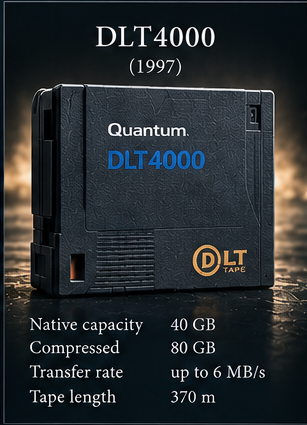 | DLT4000 | 20 GB | DLTtape IV plus supported earlier media | Common workstation/server generation. |
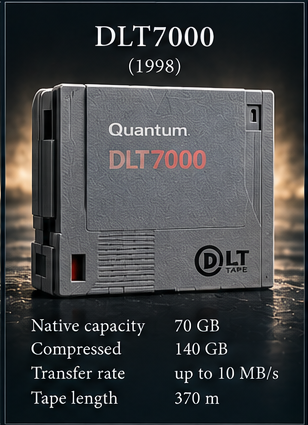 | DLT7000 | 35 GB | DLTtape IV | Higher-density recording on the same nominal DLTtape IV medium. |
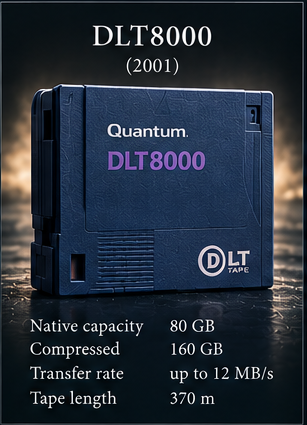 | DLT8000 | 40 GB | DLTtape IV | Classic high-end DLT and library generation. |
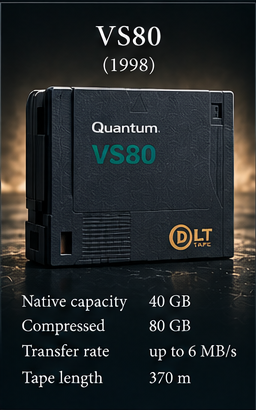 | DLT1 / VS80 | 40 GB | DLTtape IV | Value branch with a different compatibility story from classic DLT. |
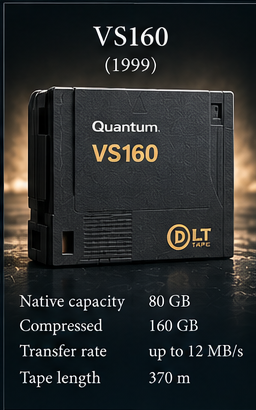 | VS160 | 80 GB | DLT VS1 | Later DLT VS branch. |
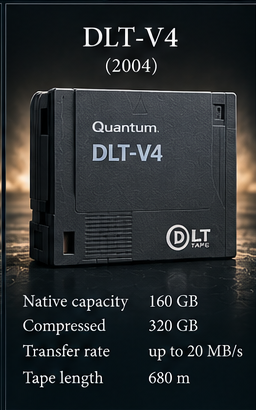 | DLT-V4 | 160 GB | DLT VS1 | Final major DLT VS generation; read/write rules are model-specific. |
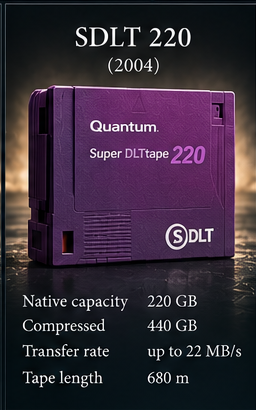 | SDLT 220 | 110 GB | SDLT I | Beginning of Super DLT. |
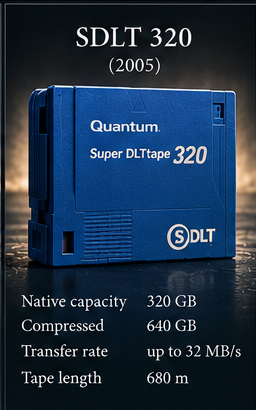 | SDLT 320 | 160 GB | SDLT I | Common SDLT server/library drive. |
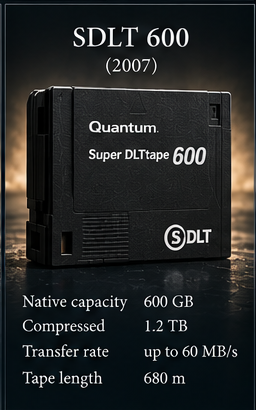 | SDLT 600 | 300 GB | SDLT II | Later SDLT generation using new media. |
Do not use a family slogan as a drive-selection rule
Quantum's product manuals are the authority for a particular transport. Broad family rules are useful only as orientation. The most important distinction is whether a drive can merely load a cartridge, actually read its recording density, or read and write it.
| Drive | Older DLTtape III/IIIXT | DLTtape IV | VS1 | SDLT I/II |
|---|---|---|---|---|
| DLT8000 | selected older DLT densities supported | R/W at supported DLT densities | no VS1 recording support | no |
| DLT VS160 | do not assume support | backward-read support depends on the exact DLT IV recording | R/W | no |
| DLT-V4 | do not assume support | selected backward read support | R/W | no |
| SDLT 320 | not a generic classic-DLT replacement | selected backward-read support in documented cases | no | R/W SDLT I |
| SDLT 600 | no general rule | legacy-read support is restricted | no | R/W SDLT II; selected SDLT I read support per manual |
The matrix intentionally avoids inventing unsupported cells. For an actual recovery, check the exact revision of the DLT8000, VS160, DLT-V4, SDLT320 or SDLT600 manual before inserting unique media.
Parallel SCSI is part of the archaeology
DLT installations span several parallel-SCSI generations, including single-ended, high-voltage differential and later LVD-era equipment. Preserve drive labels, controller cards, cables, terminators and jumper settings with the archive where possible. Connector shape alone does not establish electrical compatibility, and the wrong assumptions around older SCSI buses can create a hardware problem rather than merely a software problem.
Before diagnosing archival media, establish stable device detection, loading, unloading, rewinding and positioning using expendable media and the documentation for the installed host adapter.
A single-reel cartridge depends on the drive's take-up path
The drive draws tape from the cartridge onto an internal take-up reel. Leader and loading faults can therefore prevent access even when the recorded tape itself remains viable. DLT manuals also document cleaning indicators, cartridge handling and unload behaviour. A cartridge that refuses to load should first be treated as a mechanical or transport issue, not as proof that its recording has disappeared.
Repeatedly cycling a suspect cartridge through several unverified transports is poor preservation practice. Prove the drive first with non-unique media, then minimise stress on the archival cartridge.
Usually one volume in a larger backup set
DLT commonly carries NetBackup, NetWorker, Backup Exec, ARCserve, ADSM/Tivoli Storage Manager, Unix tar/cpio/dump, database exports and application-specific archives. Filemarks, variable block records, volume labels and tape ordering matter. Catalogue databases from the original backup server can be more valuable than a folder-level listing from a single cartridge.
Transport first, interpretation second
Identify cartridge and likely writing generation; choose a documented compatible transport; establish the host interface; verify the drive independently; preserve write protection; acquire the sequential recording while retaining filemarks and record structure; then identify backup software, volume relationships and logical contents from the copy.
This acquisition-first workflow is EOF Labs preservation practice. Cleaning, loading, manual-eject and hardware diagnostics should follow the applicable Quantum operator or product manual rather than improvised procedures.
Manufacturer documentation
[QTM-DLT8000] Quantum, DLT 8000 Product Manual. Official PDF ↗
[QTM-VS160] Quantum, DLT VS160 Installation and Operation Guide. Official PDF ↗
[QTM-DLTV4] Quantum, DLT-V4 Product Manual. Official PDF ↗
[QTM-SDLT600] Quantum, SDLT 600 Product Manual. Official PDF ↗
[QTM-DLTHB] Quantum, DLTtape Handbook. Official PDF ↗
The page deliberately leaves some historical compatibility cells qualified where a single generic rule would be unsafe. Exact drive/media operation should be resolved from the model-specific manual revision used in the recovery lab.