
AIT, S-AIT,
SLR & ADR
Four specialist backup branches grouped for identification, not compatibility. Their recording methods, cartridge geometries and host interfaces are fundamentally different.
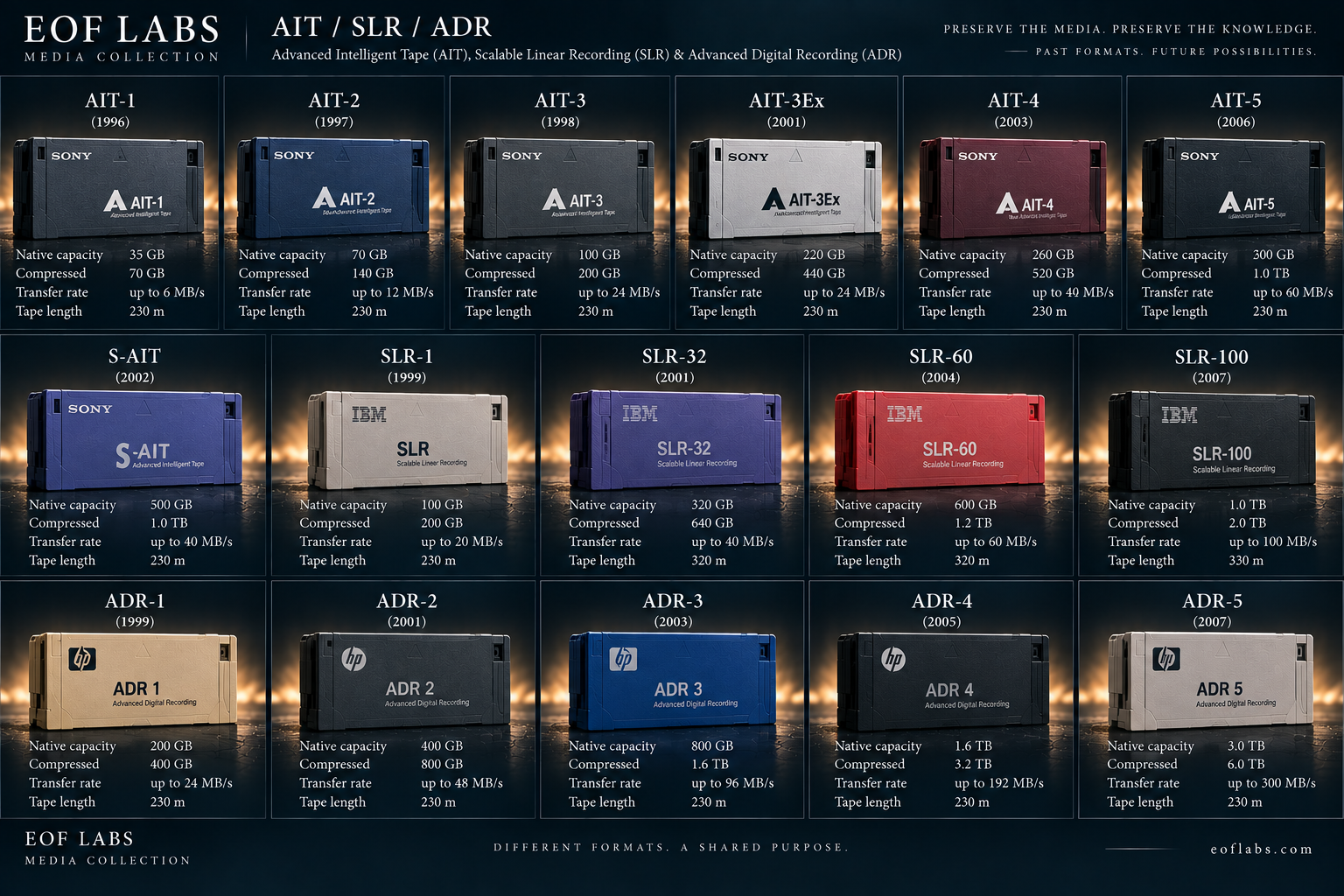
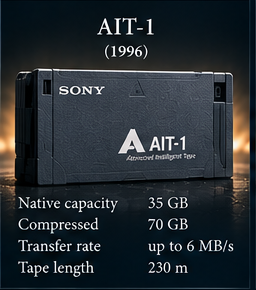
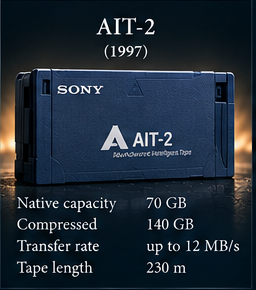
Advanced Intelligent Tape
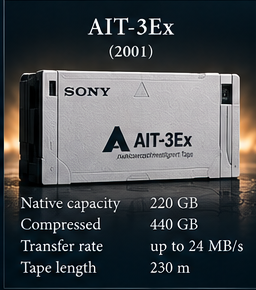
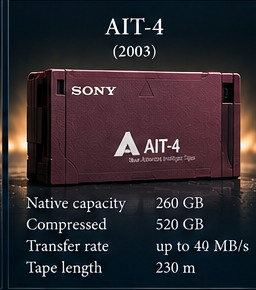
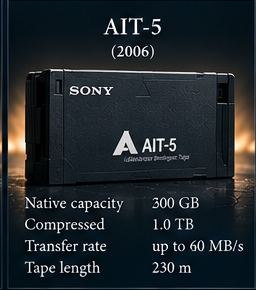
AIT combines compact 8 mm helical-scan cartridges with Sony AME media. Many cartridges incorporate Memory in Cassette (MIC), a semiconductor memory device that lets compatible drives obtain cartridge and usage information without searching the full tape. MIC is metadata support; the archive itself remains magnetically recorded.
| Generation | Native capacity | Advertised compressed capacity | Identification notes |
|---|---|---|---|
| AIT-1 | 25 GB baseline; later media/drive variants can be higher | compression-dependent | Do not collapse extended-length and Turbo-era products into one capacity value. |
| AIT-2 | 50 GB baseline | compression-dependent | Backward support is drive-specific. |
| AIT-3 | 100 GB baseline | compression-dependent | Widely deployed professional generation; Turbo variants require exact model identification. |
| AIT-4 | 200 GB | 520 GB at Sony's 2.6:1 assumption | SDX-900V documentation specifies 246 m tape and Ultra160 Wide SCSI LVD/SE. |
| AIT-5 | 400 GB | manufacturer compression figure must remain qualified | Final major compact AIT generation; Sony announced fifth-generation AIT in 2006. |
The archival catalogue should retain the full drive model, cartridge part number, generation, tape length and MIC/non-MIC status where known. AIT generation names alone are not enough to resolve every capacity or backward-read question.
What a good primary manual tells us
Sony's SDX-900V AIT-4 manual is a useful model for how EOF Labs should document obsolete tape. It distinguishes 200 GB native from 520 GB only under 2.6:1 compression, specifies a 246 m cartridge, identifies the Ultra160 Wide SCSI LVD/SE host interface, documents supported SCSI commands, explains cleaning indications and includes an emergency tape-removal procedure.
The similar name hides a different physical system
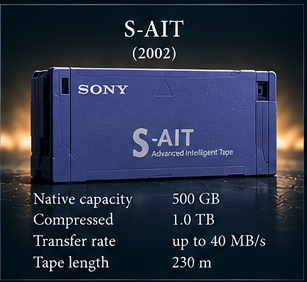
S-AIT uses a much larger half-inch single-reel cartridge and helical recording. It is not “AIT-6” and cannot be approached as a compact AIT compatibility extension. S-AIT-1 targeted enterprise libraries at roughly 500 GB native per cartridge. Recovery inventories should split AIT and S-AIT at identification time before any drive selection is attempted.
Quarter-inch cartridge evolved into professional server tape
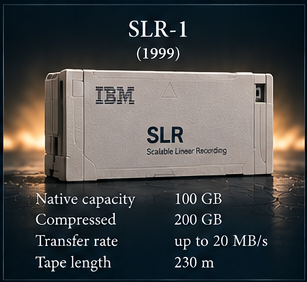
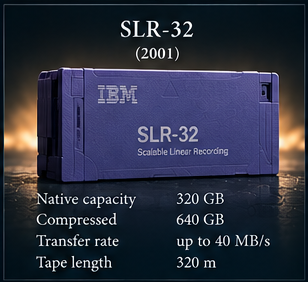
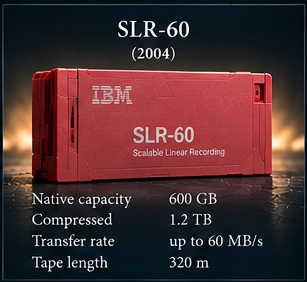
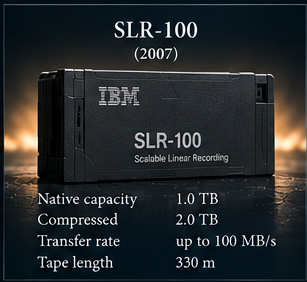
Tandberg extended QIC-derived linear recording through MLR and SLR products. SLR names such as SLR24, SLR40, SLR60, SLR75, SLR100 and SLR140 represent different capacities and media/drive generations rather than a promise that the largest-numbered drive reads everything before it.
Many SLR installations use SCSI and professional server/library contexts. The exact Tandberg installation and user's guide should govern supported cartridges, cleaning, host configuration and error interpretation. The QIC ancestry is historically useful, but it is not itself a compatibility matrix.
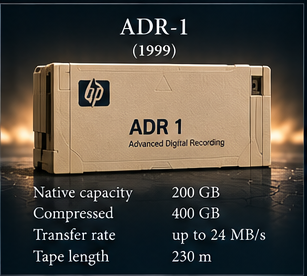
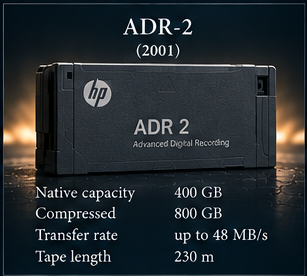
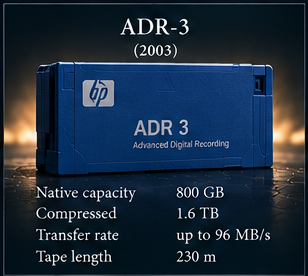
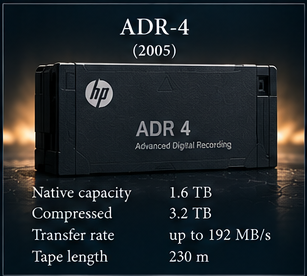
8 mm tape recorded linearly
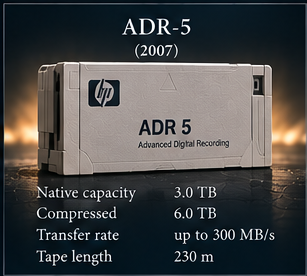
OnStream ADR is an identification trap: its tape is 8 mm wide, but it does not use the helical recording of Exabyte Data8 or Sony AIT. ADR products appeared with IDE/ATAPI, SCSI, USB and IEEE 1394/FireWire host connections, including 15/30 GB and 25/50 GB-class models.
OnStream's disappearance makes original transport hardware unusually important. Preserve the drive, power supply, host adapter, cable, software and any driver media that arrive with an ADR collection. Do not infer ADR media properties or compatibility from another 8 mm family.
Four names, four transport decisions
| Family | Tape / recording | Typical interface | Critical trap |
|---|---|---|---|
| AIT | 8 mm helical | SCSI / library variants | Looks related to other 8 mm cassettes but needs AIT transport. |
| S-AIT | ½-inch helical, single reel | professional SCSI/FC context | Not a compact-AIT generation. |
| SLR/MLR | QIC-derived linear | SCSI | QIC lineage does not imply universal Travan/QIC interchange. |
| ADR | 8 mm linear | IDE, SCSI, USB, FireWire | 8 mm width does not imply helical recording. |
Identify before loading
Photograph the cartridge and labels, record exact family/generation and part numbers, source a documented transport, verify it with expendable media and establish the correct host interface. Preserve sequential filemarks and records during acquisition. The resulting stream may contain tar/cpio/dump or commercial backup software and should be interpreted independently from the original medium.
OEM manuals remain the authority for normal cleaning, error indications and emergency unload procedures. EOF Labs' acquisition-first workflow is a preservation practice layered on top of those manufacturer procedures.
Manufacturer and archived manufacturer documentation
[SONY-AIT4] Sony, AIT-4 Tape Drive SDX-900V Series User's Guide. Official PDF ↗
[SONY-AIT] Sony, SDX-1100V/900V/800V Series User's Guide. Official PDF ↗
[SONY-AIT5] Sony Electronics, Sony Delivers Fifth Generation AIT Format, 2006. Sony announcement ↗
[TANDBERG-SLR] Tandberg Data, SLR Tape Storage Installation and User's Guide, preserved by Internet Archive/Bitsavers. Archived primary document ↗
[ONSTREAM-SC30] OnStream, SC30 User Guide, preserved by Internet Archive. Archived document ↗